

An Amazing Italian Holiday: Celebrating the Joy of Christmas and New Year’s Eve
Christmas and New Year’s Eve: Exploring Italy’s Deeply Rooted Catholic Traditions
The festive season in Italy is much more than just a few days of holiday cheer; it’s a rich, extended tapestry woven from Italian Catholic culture, history, and generations of family tradition. Unlike in many places, the celebration doesn’t begin on December 25th or end on January 1st; instead, it’s a magnificent period of warmth, reflection, and spectacular feasts that stretches from the Feast of the Immaculate Conception on December 8th all the way through the Epiphany on January 6th.
This span of time, especially during the Italian Christmas and New Year’s holidays, is marked by unique customs—from the sacred quiet of religious observance to the joyous explosion of a New Year’s celebration. It’s a time when family reigns supreme, and the shared table becomes the very heart of the celebration.

The Artistic Heart of the Season: The Nativity Scene
The most enduring and beautiful symbol of Christmas traditions in Italy is the Presepe, or nativity scene. This isn’t just a simple decoration; it is an art form. It’s an important aspect of the holiday, much more central than the Christmas tree in many households. The tradition is widely credited to Saint Francis of Assisi, who created the first living nativity scene in 1223.
Today, the creation of elaborate nativity scenes is an annual ritual, with Naples’ San Gregorio Armeno street being world-renowned for its artisanal figurines. These scenes often depict not just the Holy Family but an entire 18th or 19th-century village bustling with daily life—bakers, market vendors, and shepherds—all frozen in time around the central mystery of the manger. Putting up the nativity scene, or a similar religious display, is a treasured activity that helps families focus on the religious core of the season. The figure of the Baby Jesus is often the last to be placed, arriving at the stroke of midnight on Christmas Eve.
The Feast of the Season: From Fish to Zampone
Italian holiday celebrations are famously centered on food, and the dining table is where family memories are truly made. The festive meals begin on Christmas Eve, known as La Vigilia. Rooted in Catholic abstinence, the traditional meal is light (meatless) and often features a variety of seafood dishes. For Italian-American families, this tradition evolved into the Feast of the Seven Fishes, though in Italy, the meal is known simply as vigilia and the number of fish dishes is highly regional and not strictly counted. Dishes can include everything from fried cod to baked eel.
The real culinary splendor arrives on Christmas Day. Families gather for large family feasts that are long, loud, and full of rich regional specialties. Northern Italy might feature tortellini in brodo (small, meat-filled pasta in broth), while the South serves up oven-baked pasta dishes like lasagne. The main courses often involve roasted meats, followed by the “battle of the desserts” between Panettone (a tall, dome-shaped bread with candied fruit) and Pandoro (a golden, star-shaped cake dusted with powdered sugar).
The feasting continues through New Year’s Eve, known as Capodanno or Notte di San Silvestro. The midnight meal is a crucial tradition featuring foods believed to bring good luck and prosperity for the coming year. The essential dish is pork—often zampone (stuffed pig’s trotter) or cotechino (large, boiled pork sausage)—served with lentils. The lentil’s small, coin-like shape symbolizes wealth, ensuring the year ahead is financially bountiful.
Ringing in Buon Anno: New Year’s Eve and Good Fortune
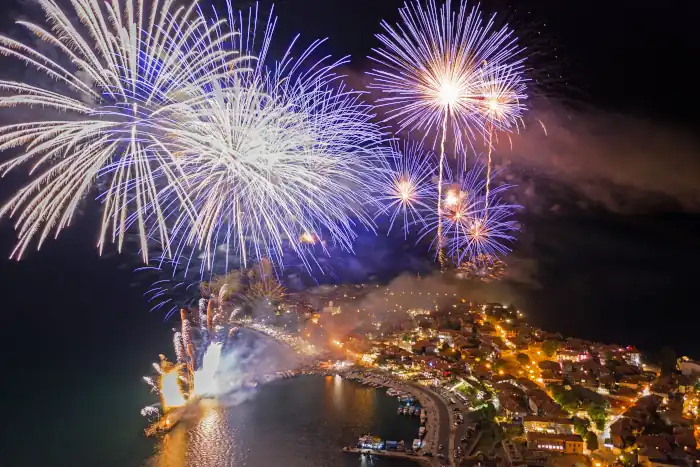
New Year’s Eve features public fireworks, concerts, and parties across Italy. City centers, like Rome’s Piazza del Popolo or Piazza Navona, become vibrant hubs of celebration. But many key customs are personal and intended to influence one’s luck for the next 365 days.
One of the most famous and fun superstitions is the tradition of wearing red underwear for good luck and prosperity. It’s a whimsical nod to ancient Roman tradition, and you’ll see red garments prominently displayed in shop windows throughout December. As the clock strikes midnight, everyone shares a heartfelt toast with sparkling wine, usually Spumante or Prosecco, shouting “Buon anno!” (Happy New Year!). Another popular, though less common now, ancient tradition in the South was to throw old or unused items out of the window as a way to symbolically “out with the old” and welcome a fresh start.
After the Christmas and New Year’s Eve celebrations, the holiday season doesn’t conclude until January 6th, the Feast of the Epiphany. This day introduces another unique and much-loved Italian figure: La Befana.
- Christmas Gifts for Women Hummingbird Solar Lanterns Outdoor Waterproof…
- Shower Steamers Aromatherapy – USA Made with Natural Ingredients & Lavender…
- 48PCS New Years Eve Party Supplies 2026 for 24 Guests, Happy New Years…
- Emergency Survival Kit and First Aid Kit, 142Pcs Professional Survival Gear…
- Zigzagger Men's Slip On Moccasin Slippers, Indoor/Outdoor Warm Fuzzy Comfy…
- Loowoko Heated Vest for Men with Battery Pack Included, Rechargeable Electric…
- Garden Tools Set, JUMPHIGH 10 Pieces Gardening Tools with Floral Print,…
La Befana and the End of the Season
The tradition of La Befana is a fascinating fusion of ancient folklore and Catholic custom. She is an old, witch-like figure who flies on a broomstick, covered in soot because she enters homes through the chimney. Her name is a linguistic evolution of Epifania (Epiphany).
La Befana delivers gifts and sweets to good children and a piece of coal (nowadays, it’s usually black sugar candy) to naughty ones. Children hang their stockings, eagerly awaiting her arrival on the night of January 5th. According to legend, she was an old woman who declined an invitation to join the Three Wise Men on their journey to Bethlehem. Filled with regret, she now flies around perpetually, giving gifts to all children in the hopes of finding the Baby Jesus. Her procession of La Befana on January 5th and the following day marks the final, joyful close of the Italian holiday season.
A Short Reflection: Tradition Across the Continents
When comparing Christmas and New Year’s Eve celebrations in Italy with those in the U.S. and the rest of the world, what stands out is the deep, historical integration of Catholic faith into the cultural customs. In the United States, while religious observance is important to many, the overall celebration is often dominated by commercial elements, the figure of Santa Claus, and a focus on gift exchange on December 25th. The celebration is often wrapped up quickly, sometimes even before New Year’s Day.
In Italy, the emphasis is more balanced. The holiday season is a much longer event, and the focus remains heavily on family connection, regional food traditions, and the spiritual narrative, beautifully embodied by the Presepe and the enduring folklore of La Befana. This slow, deliberate celebration highlights how the two periods—Christmas and New Year’s Eve—flow seamlessly together as a single, sacred, and joyous period of spending quality time with family and friends. Italy shows us the beautiful power of carrying ancient stories forward, ensuring that every feast and every tradition has a rich layer of meaning beyond the bright lights and presents.
If you’ve enjoyed this glimpse into the vibrant heart of the Italian festive season, why not delve deeper? Take a moment to think about one of your own cherished family traditions from your childhood. What’s the story behind it, and what does it truly mean to you? It’s these shared memories and stories that give the holidays their real magic.






Share: